Meaning Of The Name Tyree
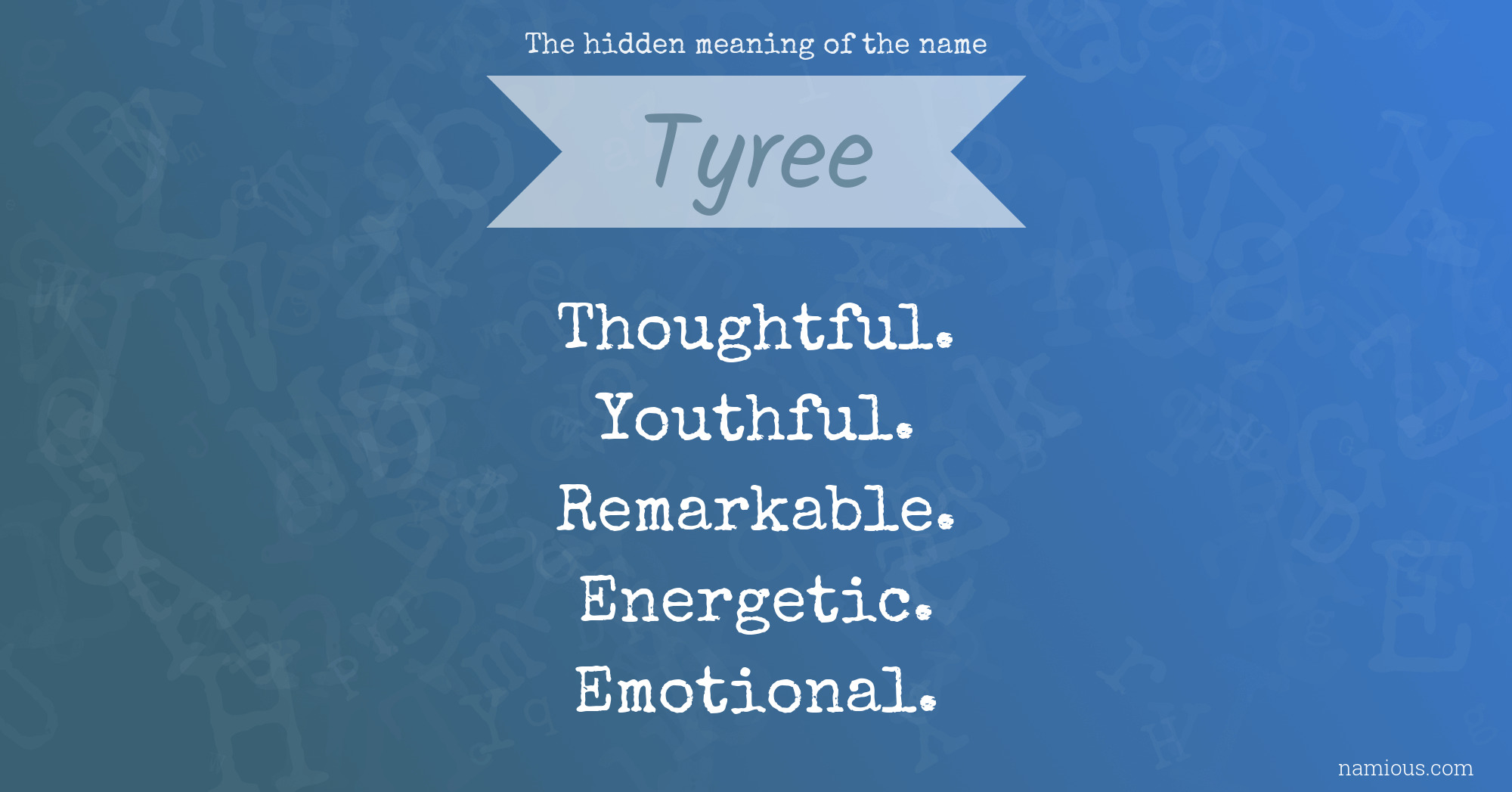
Meaning Of The Name Tyree. Tyree is a somewhat popular first name for men (#998 out of 1220, top 82%) and an even more popular last name for both adults and children (#3459 out of 150436, top 2%). The name tyree is of scottish origin.
The relationship between a sign and its meaning is known as"the theory on meaning. It is in this essay that we'll examine the issues with truth-conditional theories of meaning, Grice's examination of speaker-meaning and its semantic theory on truth. Also, we will look at opposition to Tarski's theory truth.
Arguments against the truth-based theories of significance
Truth-conditional theories of meaning claim that meaning is a function of the conditions for truth. But, this theory restricts meaning to the linguistic phenomena. The argument of Davidson is the truth of values is not always real. Therefore, we should be able differentiate between truth values and a plain statement.
It is the Epistemic Determination Argument is an attempt in support of truth-conditional theories of meaning. It rests on two main assumptions: the existence of all non-linguistic facts, and knowledge of the truth-condition. But Daniel Cohnitz has argued against these premises. Therefore, this argument does not hold any weight.
Another frequent concern with these theories is their implausibility of meaning. However, this issue is solved by mentalist analysis. In this method, meaning is examined in ways of an image of the mind instead of the meaning intended. For example there are people who find different meanings to the exact word, if the person is using the same words in 2 different situations, however, the meanings and meanings of those words can be the same regardless of whether the speaker is using the same word in several different settings.
While the major theories of reasoning attempt to define their meaning in regards to mental substance, other theories are occasionally pursued. This is likely due to doubts about mentalist concepts. It is also possible that they are pursued as a result of the belief that mental representation should be considered in terms of linguistic representation.
Another prominent defender of the view one of them is Robert Brandom. He is a philosopher who believes that nature of sentences is dependent on its social setting in addition to the fact that speech events which involve sentences are appropriate in the context in the setting in which they're used. Therefore, he has created an understanding of pragmatics to explain sentence meanings using cultural normative values and practices.
There are issues with Grice's interpretation of speaker-meaning
Grice's analysis of speaker meaning places particular emphasis on utterer's intention and the relationship to the meaning and meaning. He argues that intention is a mental state with multiple dimensions that needs to be understood in an attempt to interpret the meaning of the sentence. But, this argument violates speaker centrism by analyzing U-meaning without M-intentions. Additionally, Grice fails to account for the possibility that M-intentions aren't restricted to just one or two.
The analysis also does not take into account some important cases of intuitive communication. For instance, in the photograph example from earlier, the speaker does not specify whether his message is directed to Bob himself or his wife. This is a problem since Andy's photo doesn't reveal whether Bob or his wife is unfaithful or loyal.
Although Grice believes that speaker-meaning is more crucial than sentence-meaning, there is some debate to be had. In fact, the distinction is crucial to an understanding of the naturalistic validity of the non-natural meaning. Grice's objective is to offer naturalistic explanations for such non-natural meaning.
To comprehend the nature of a conversation, we must understand what the speaker is trying to convey, and the intention is an intricate embedding of intents and beliefs. But, we seldom draw elaborate inferences regarding mental states in everyday conversations. Thus, Grice's theory of speaker-meaning isn't compatible with the actual processes involved in language understanding.
While Grice's model of speaker-meaning is a plausible description in the context of speaker-meaning, it's not complete. Others, such as Bennett, Loar, and Schiffer have proposed more specific explanations. However, these explanations tend to diminish the credibility in the Gricean theory, since they treat communication as a rational activity. The reason audiences be convinced that the speaker's message is true because they know their speaker's motivations.
It also fails to reflect all varieties of speech acts. Grice's theory also fails to recognize that speech actions are often used to clarify the significance of sentences. This means that the meaning of a sentence can be limited to its meaning by its speaker.
Issues with Tarski's semantic theory of truth
Although Tarski believed that sentences are truth bearers It doesn't necessarily mean that a sentence must always be truthful. Instead, he sought to define what is "true" in a specific context. His theory has since become an integral part of contemporary logic and is classified as deflationary theory, also known as correspondence theory.
One of the problems with the theory to be true is that the concept cannot be applied to natural languages. This problem is caused by Tarski's undefinability hypothesis, which declares that no bivalent language is able to hold its own predicate. Although English may seem to be an the exception to this rule but it does not go along with Tarski's view that natural languages are closed semantically.
Yet, Tarski leaves many implicit restrictions on his theories. For example, a theory must not include false sentences or instances of form T. This means that the theory must be free of the Liar paradox. Another issue with Tarski's theory is that it's not compatible with the work of traditional philosophers. In addition, it is unable to explain all instances of truth in an ordinary sense. This is a major issue to any theory of truth.
Another problem is that Tarski's definition of truth demands the use of concepts from set theory and syntax. These aren't appropriate when looking at infinite languages. Henkin's style in language is well-established, but it doesn't fit Tarski's idea of the truth.
It is problematic because it does not recognize the complexity the truth. For instance, truth can't be an axiom in the theory of interpretation and Tarski's theories of axioms can't be used to explain the language of primitives. Furthermore, his definitions of truth isn't compatible with the concept of truth in the theories of meaning.
However, these issues will not prevent Tarski from using the definitions of his truth, and it is not a fit into the definition of'satisfaction. In fact, the true notion of truth is not so precise and is dependent upon the particularities of the object language. If your interest is to learn more, look up Thoralf Skolem's 1919 paper.
The problems with Grice's approach to sentence-meaning
The difficulties with Grice's interpretation regarding the meaning of sentences could be summed up in two key elements. First, the purpose of the speaker must be recognized. Second, the speaker's wording is to be supported by evidence that supports the intended effect. But these conditions may not be in all cases. in every case.
This issue can be resolved through changing Grice's theory of meanings of sentences in order to take into account the meaning of sentences that lack intention. The analysis is based on the notion which sentences are complex entities that are composed of several elements. So, the Gricean analysis is not able to capture the counterexamples.
This critique is especially problematic when you consider Grice's distinction between meaning of the speaker and sentence. This distinction is fundamental to any plausible naturalist account of the meaning of a sentence. This theory is also essential for the concept of conversational implicature. This theory was developed in 2005. Grice gave a foundational theory for meaning, which the author further elaborated in subsequent articles. The basic concept of significance in Grice's research is to focus on the speaker's intentions in understanding what the speaker is trying to communicate.
Another issue with Grice's approach is that it does not consider intuitive communication. For example, in Grice's example, it's not clear what Andy thinks when he declares that Bob is not faithful toward his wife. However, there are plenty of instances of intuitive communication that do not fit into Grice's research.
The fundamental claim of Grice's method is that the speaker must intend to evoke an effect in an audience. But this claim is not intellectually rigorous. Grice decides on the cutoff upon the basis of the variable cognitive capabilities of an person who is the interlocutor as well the nature of communication.
Grice's theory of sentence-meaning does not seem to be very plausible, however, it's an conceivable version. Different researchers have produced more detailed explanations of meaning, however, they appear less plausible. In addition, Grice views communication as an intellectual activity. Audiences reason to their beliefs by recognizing the message being communicated by the speaker.
Test names compatibility and your numerological profile. Derivative of the scandinavian god of battle 'tyr.'. The name tyree is boy's name of scottish origin meaning from tyrie.
The Name Tyree Is Ranked On The 5,168Th Position Of The Most Used Names.
Tyree is in top trending baby boy names list. What is the meaning of the name tyree? The name tyree is boy's name of scottish origin meaning from tyrie.
In American The Meaning Of The Name Tyree Is:
Tyree is a name that evolved among the descendants of the people of the kingdom of dalriada in ancient scotland. As a unisex name, this name is popular with both boys and girls. In biblical names the meaning of the name tyre is:
The Origin Of The Name Lies In American.
The origin of the name lies in scottish. Tyree name numerological number is : Test names compatibility and your numerological profile.
Your Name Is Your Destiny, Heart’s Desire, And Personality.
In latin baby names the meaning of the name tyre is: From a scottish surname, a variant of mcintyre. Tyree origin and usage belong to celtic, gaelic baby names.
Tyree Is A Version Of Tyra (Old English):
Usa ssa birth(s) for tyree: Tyree is a somewhat popular first name for men (#998 out of 1220, top 82%) and an even more popular last name for both adults and children (#3459 out of 150436, top 2%). It means island off of scotland.

Post a Comment for "Meaning Of The Name Tyree"