Dont Mention It Meaning
Dont Mention It Meaning. I found, in almost every dictionary, that don't mention it is a polite expression used to indicate. Definition of don't mention it in the idioms dictionary.
The relationship between a sign and its meaning is known as the theory of meaning. This article we will examine the issues with truth-conditional theories of meaning, Grice's study of the meaning of the speaker and Sarski's theory of semantic truth. We will also look at opposition to Tarski's theory truth.
Arguments against truth-conditional theories of significance
Truth-conditional theories of Meaning claim that meaning is a function of the elements of truth. But, this theory restricts definition to the linguistic phenomena. The argument of Davidson is that truth-values are not always real. So, we need to be able to distinguish between truth and flat statement.
The Epistemic Determination Argument is a way to prove the truthfulness of theories of meaning. It is based upon two basic principles: the completeness of nonlinguistic facts and knowledge of the truth-condition. But Daniel Cohnitz has argued against these premises. This argument therefore does not hold any weight.
Another concern that people have with these theories is the incredibility of meaning. However, this issue is dealt with by the mentalist approach. In this way, the meaning can be examined in ways of an image of the mind, rather than the intended meaning. For example that a person may see different meanings for the words when the individual uses the same word in two different contexts, but the meanings behind those words could be identical regardless of whether the speaker is using the same word in two different contexts.
Although most theories of reasoning attempt to define what is meant in way of mental material, other theories are occasionally pursued. This could be because of the skepticism towards mentalist theories. They can also be pushed through those who feel mental representation must be examined in terms of the representation of language.
Another major defender of the view one of them is Robert Brandom. He is a philosopher who believes that value of a sentence dependent on its social context and that the speech actions using a sentence are suitable in the context in the situation in which they're employed. So, he's developed a pragmatics concept to explain sentence meanings using normative and social practices.
Probleme with Grice's approach to speaker-meaning
Grice's analysis based on speaker-meaning puts an emphasis on the speaker's intentions and their relation to the meaning of the statement. He believes that intention is an intricate mental state that needs to be understood in order to grasp the meaning of the sentence. However, this approach violates speaker centrism because it examines U meaning without M-intentions. In addition, Grice fails to account for the fact that M-intentions are not constrained to just two or one.
Further, Grice's study isn't able to take into account critical instances of intuitive communication. For instance, in the photograph example previously mentioned, the speaker doesn't make it clear whether they were referring to Bob either his wife. This is a problem since Andy's photograph doesn't indicate whether Bob as well as his spouse are unfaithful or loyal.
Although Grice is correct the speaker's meaning is more fundamental than sentence-meanings, there is some debate to be had. In actual fact, this distinction is essential to the naturalistic acceptance of non-natural meaning. In the end, Grice's mission is to provide naturalistic explanations and explanations for these non-natural meaning.
To appreciate a gesture of communication one has to know the intention of the speaker, and this intention is an intricate embedding of intents and beliefs. Yet, we do not make elaborate inferences regarding mental states in regular exchanges of communication. Thus, Grice's theory of speaker-meaning isn't compatible with the actual psychological processes that are involved in language comprehension.
While Grice's explanation of speaker meaning is a plausible explanation about the processing, it's still far from being complete. Others, such as Bennett, Loar, and Schiffer have proposed more in-depth explanations. These explanations, however, tend to diminish the plausibility of Gricean theory because they consider communication to be an activity that is rational. In essence, the audience is able to trust what a speaker has to say as they can discern the speaker's intention.
In addition, it fails to provide a comprehensive account of all types of speech act. Grice's model also fails consider the fact that speech acts are frequently used to clarify the meaning of sentences. The result is that the value of a phrase is reduced to the meaning of the speaker.
Problems with Tarski's semantic theories of truth
Although Tarski declared that sentences are truth-bearing But this doesn't imply that a sentence must always be truthful. Instead, he sought to define what is "true" in a specific context. The theory is now an integral part of contemporary logic and is classified as a correspondence or deflationary theory.
One drawback with the theory of truth is that it can't be applied to any natural language. This problem is caused by Tarski's undefinability theory, which states that no bivalent dialect can be able to contain its own predicate. Although English may seem to be an the exception to this rule but this is in no way inconsistent in Tarski's opinion that natural languages are closed semantically.
Yet, Tarski leaves many implicit constraints on his theory. For example the theory cannot contain false sentences or instances of form T. In other words, the theory must be free of the Liar paradox. Another issue with Tarski's theory is that it isn't conforming to the ideas of traditional philosophers. Furthermore, it cannot explain all truthful situations in terms of the common sense. This is a major challenge for any theory about truth.
The other issue is that Tarski's definitions for truth demands the use of concepts of set theory and syntax. They are not suitable in the context of infinite languages. Henkin's style of speaking is well-founded, however it does not fit with Tarski's definition of truth.
In Tarski's view, the definition of truth also insufficient because it fails to consider the complexity of the truth. Truth, for instance, cannot play the role of a predicate in the theory of interpretation and Tarski's theories of axioms can't clarify the meaning of primitives. Further, his definition on truth isn't in accordance with the notion of truth in definition theories.
These issues, however, can not stop Tarski from applying the definitions of his truth, and it doesn't fall into the'satisfaction' definition. The actual definition of the word truth isn't quite as straightforward and depends on the particularities of object languages. If you're interested to know more, read Thoralf's 1919 work.
Problems with Grice's analysis of sentence-meaning
The problems that Grice's analysis has with its analysis of sentence meanings can be summed up in two main points. In the first place, the intention of the speaker needs to be understood. The speaker's words must be accompanied by evidence that supports the intended effect. But these conditions may not be achieved in every instance.
This issue can be resolved with the modification of Grice's method of analyzing phrase-based meaning, which includes the meaning of sentences which do not possess intentionality. This analysis is also based on the notion that sentences can be described as complex entities that contain several fundamental elements. As such, the Gricean analysis fails to recognize instances that could be counterexamples.
This is particularly problematic with regard to Grice's distinctions between speaker-meaning and sentence-meaning. This distinction is the foundational element of any naturalistically respectable account of sentence-meaning. The theory is also fundamental for the concept of implicature in conversation. On the 27th of May, 1957 Grice proposed a starting point for a theoretical understanding of the meaning that he elaborated in later studies. The basic notion of significance in Grice's work is to analyze the intention of the speaker in determining what the speaker intends to convey.
Another issue with Grice's analysis is that it doesn't include intuitive communication. For instance, in Grice's example, it is not clear what Andy is referring to when he says that Bob is unfaithful for his wife. Yet, there are many examples of intuition-based communication that do not fit into Grice's study.
The basic premise of Grice's approach is that a speaker has to be intending to create an emotion in viewers. This isn't in any way philosophically rigorous. Grice fixes the cutoff point in the context of possible cognitive capabilities of the speaker and the nature communication.
Grice's understanding of sentence-meaning doesn't seem very convincing, however it's an plausible analysis. Some researchers have offered more specific explanations of meaning, but they seem less plausible. In addition, Grice views communication as an activity that can be rationalized. The audience is able to reason by observing the speaker's intent.
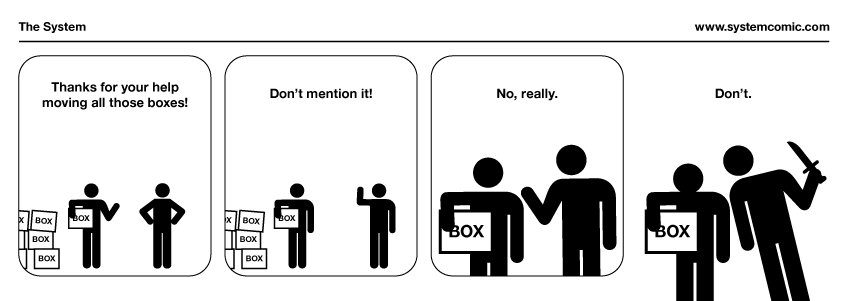
Do not say you're welcome! But for me, the word means something like don't go around talking. People sometimes say ' don't mention it ' as a polite reply to someone who has just thanked them for doing something.
From Longman Dictionary Of Contemporary English Don’t Mention It Spoken Used To Say Politely That There Is No Need For Someone To Thank You For Helping Them ‘Thanks For The.
English (us) french (france) german italian japanese. It was the least i. What does not to mention expression mean?
Do Not Say You're Welcome!
Used as a polite answer to someone who has just thanked you for something. I'm at your service anytime. What does don't mention it expression mean?
Don't Even Mention It People Say It When They Are Angry Example:
Said to be polite after someone has thanked you: The meaning of don't mention it is —used to answer someone who has just thanked one for something. Definition of not to mention in the idioms dictionary.
It Doesn't At All Mean Don't Go Around Talking About This To Anyone. It Is In Fact Much Closer To You're Welcome. When You Are Telling Someone Don't Mention It, What You Are Telling Them.
But for me, the word means something like don't go around talking. And so, for once in a way, i really do want to make use of you.’. How to use don't mention it in a sentence.
Because It Is An Idiom, It Is A Fixed Phrase Whose Meaning Can’t Be Deduced From The.
People sometimes say ' don't mention it ' as a polite reply to someone who has just. You should drink some water and go to lie down. Don’t mention it definitions and synonyms.

Post a Comment for "Dont Mention It Meaning"