Carrot Egg Coffee Meaning
Carrot Egg Coffee Meaning. The egg had been fragile. She filled three pots with water.
The relationship between a symbol with its purpose is called"the theory" of the meaning. Here, we'll analyze the shortcomings of truth-conditional theories of meaning, Grice's analysis of meanings given by the speaker, as well as the semantic theories of Tarski. We will also consider the arguments that Tarski's theory of truth.
Arguments against truth-conditional theories of significance
Truth-conditional theories for meaning say that meaning is a function on the truthful conditions. However, this theory limits the meaning of linguistic phenomena to. Davidson's argument essentially argues the truth of values is not always correct. This is why we must know the difference between truth-values from a flat assertion.
The Epistemic Determination Argument is an attempt to prove the truthfulness of theories of meaning. It relies upon two fundamental beliefs: omniscience of nonlinguistic facts as well as understanding of the truth-condition. However, Daniel Cohnitz has argued against these assumptions. This argument therefore is devoid of merit.
Another issue that is frequently raised with these theories is the incredibility of meaning. The problem is tackled by a mentalist study. This way, meaning can be examined in way of representations of the brain rather than the intended meaning. For instance one person could get different meanings from the exact word, if the person uses the same word in the context of two distinct contexts, however, the meanings and meanings of those words could be similar depending on the context in which the speaker is using the same word in the context of two distinct situations.
Though the vast majority of theories that are based on the foundation of meaning try to explain the meaning in regards to mental substance, non-mentalist theories are often pursued. This could be because of suspicion of mentalist theories. It is also possible that they are pursued through those who feel that mental representation needs to be examined in terms of linguistic representation.
One of the most prominent advocates of this idea is Robert Brandom. He believes that the nature of sentences is determined by its social context and that the speech actions related to sentences are appropriate in an environment in where they're being used. So, he's come up with a pragmatics model to explain sentence meanings by using normative and social practices.
Grice's analysis of speaker-meaning
Grice's analysis on speaker-meaning places large emphasis on the speaker's intention and how it relates to the significance of the sentence. Grice believes that intention is a complex mental state that needs to be considered in order to understand the meaning of sentences. But, this argument violates speaker centrism because it examines U meaning without considering M-intentions. In addition, Grice fails to account for the fact that M-intentions don't have to be limitless to one or two.
The analysis also doesn't account for significant instances of intuitive communication. For instance, in the photograph example from earlier, a speaker does not make clear if she was talking about Bob himself or his wife. This is problematic since Andy's picture doesn't show the fact that Bob nor his wife is unfaithful or loyal.
While Grice believes speaking-meaning is more fundamental than sentence-meanings, there is some debate to be had. In fact, the distinction is essential to an understanding of the naturalistic validity of the non-natural meaning. Indeed, the purpose of Grice's work is to present naturalistic explanations for the non-natural meaning.
To fully comprehend a verbal act one has to know the speaker's intention, and this intention is complex in its embedding of intentions and beliefs. But, we seldom draw complicated inferences about the state of mind in the course of everyday communication. Consequently, Grice's analysis of speaker-meaning isn't compatible with the actual cognitive processes involved in the comprehension of language.
While Grice's description of speaker-meaning is a plausible description to explain the mechanism, it's but far from complete. Others, such as Bennett, Loar, and Schiffer have proposed more precise explanations. These explanations, however, tend to diminish the credibility for the Gricean theory, since they view communication as an activity rational. Fundamentally, audiences be convinced that the speaker's message is true since they are aware of that the speaker's message is clear.
Additionally, it doesn't explain all kinds of speech acts. Grice's analysis also fails to consider the fact that speech acts can be used to explain the significance of sentences. The result is that the purpose of a sentence gets reduced to the meaning of the speaker.
Problems with Tarski's semantic theories of truth
While Tarski asserted that sentences are truth bearers This doesn't mean any sentence has to be truthful. He instead attempted to define what is "true" in a specific context. His theory has since become an integral component of modern logic, and is classified as a deflationary or correspondence theory.
The problem with the concept for truth is it is unable to be applied to any natural language. The reason for this is Tarski's undefinability thesis, which states that no bivalent dialect is able to have its own truth predicate. While English may seem to be an an exception to this rule This is not in contradiction with Tarski's view that natural languages are semantically closed.
Yet, Tarski leaves many implicit limitations on his theory. For example the theory should not contain false statements or instances of the form T. That is, theories must not be able to avoid what is known as the Liar paradox. Another drawback with Tarski's theory is that it isn't conforming to the ideas of traditional philosophers. Furthermore, it cannot explain every aspect of truth in an ordinary sense. This is an issue to any theory of truth.
The second problem is that Tarski's definition is based on notions of set theory and syntax. These are not the best choices when considering infinite languages. Henkin's style of language is based on sound reasoning, however it doesn't fit Tarski's conception of truth.
Tarski's definition of truth is also insufficient because it fails to make sense of the complexity of the truth. In particular, truth is not able to play the role of an axiom in the context of an interpretation theory, and Tarski's principles cannot define the meaning of primitives. In addition, his definition of truth does not align with the concept of truth in interpretation theories.
However, these limitations will not prevent Tarski from using his definition of truth and it doesn't fall into the'satisfaction' definition. In fact, the exact notion of truth is not so simple and is based on the peculiarities of language objects. If you'd like to learn more about the subject, then read Thoralf Skolem's 1919 article.
Problems with Grice's analysis of sentence-meaning
The difficulties in Grice's study of meaning of sentences can be summed up in two main points. First, the intentions of the speaker has to be recognized. Furthermore, the words spoken by the speaker must be supported by evidence demonstrating the intended effect. But these conditions are not fully met in every instance.
This issue can be resolved with the modification of Grice's method of analyzing meaning of sentences, to encompass the significance of sentences that do not have intentionality. The analysis is based on the notion sentence meanings are complicated and have many basic components. In this way, the Gricean approach isn't able capture contradictory examples.
This is particularly problematic when we look at Grice's distinctions among meaning of the speaker and sentence. This distinction is essential to any naturalistically sound account of sentence-meaning. This theory is also crucial for the concept of implicature in conversation. On the 27th of May, 1957 Grice established a base theory of significance, which he elaborated in subsequent papers. The fundamental idea behind the concept of meaning in Grice's work is to think about the speaker's motives in determining what message the speaker wants to convey.
Another issue with Grice's theory is that it does not include intuitive communication. For instance, in Grice's example, there is no clear understanding of what Andy intends to mean when he claims that Bob is unfaithful of his wife. However, there are a lot of counterexamples of intuitive communication that cannot be explained by Grice's theory.
The main claim of Grice's analysis requires that the speaker is required to intend to cause an effect in those in the crowd. But this isn't rationally rigorous. Grice establishes the cutoff upon the basis of the an individual's cognitive abilities of the partner and on the nature of communication.
Grice's analysis of sentence-meaning doesn't seem very convincing, however it's an plausible account. Other researchers have devised more precise explanations for meaning, but they seem less plausible. Furthermore, Grice views communication as the activity of rationality. Audiences make their own decisions because they are aware of the speaker's intent.
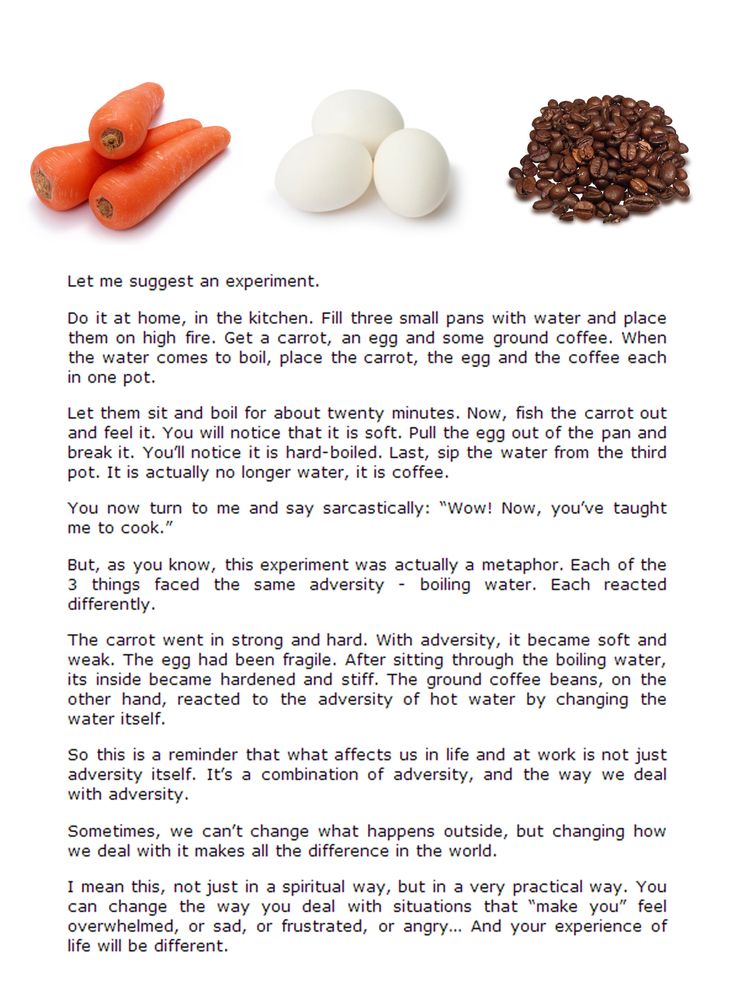
The egg, carrot and coffee represents the different responses and reactions to these circumstances. Like a carrot, adversity can soften us. She did and noted that.
Consider How Differently Carrots, Eggs, And Ground Coffee Beans Are Affected By The Extreme Adversity Of Being Boiled.
What does ‘carrot, egg or coffee’ mean? The carrot goes in strong, hard and unrelenting, but after being subjected to the boiling water, it softened and became weak. The carrot went into the hot water hard and unrelenting but came out soft, wobbly, and weak.
Because Of Our Personalities, Our Temperaments, Our.
The carrot went in strong, hard, and unrelenting. She did not know how she was going to make it. In the first pot she placed carrots, in the second she placed eggs, and in the last she placed a pouch of ground coffee beans.
The Carrot Went Into The Boiling Water Strong And Unrelenting.
The carrot started out hard and strong but came out weak. A young woman went to her grandmother and told her about her life and how things. The egg had been fragile.
The Carrot Went In Strong And Hard And Unrelenting But After Being In The Water Softened And Became Weaker.
The main constituents of coffee are. We can emerge more flexible, understanding, compassionate, and grateful, or we can let our life spirit turn into a soft mush. She was tired of fighting and struggling.
“Carrots, Eggs, And Coffee,” She Replied.
Then he filled three containers with water and put them over fire. She filled three pots with water. Its thin outer shell had.

Post a Comment for "Carrot Egg Coffee Meaning"