Tower Moment Spiritual Meaning
Tower Moment Spiritual Meaning. The tower in the tarot. After a tower experience, you will grow stronger, wiser and more resilient as you develop a new perspective on life you did not even know existed.
The relationship between a sign that is meaningful and its interpretation is known as"the theory" of the meaning. Within this post, we will discuss the challenges of truth-conditional theories regarding meaning, Grice's assessment on speaker-meaning and The semantics of Truth proposed by Tarski. We will also look at arguments against Tarski's theory of truth.
Arguments against truth-based theories of meaning
Truth-conditional theories of meaning claim that meaning is a function in the conditions that define truth. However, this theory limits interpretation to the linguistic phenomenon. A Davidson argument basically argues that truth-values aren't always accurate. Therefore, we must be able to discern between truth-values as opposed to a flat claim.
It is the Epistemic Determination Argument is an attempt to argue for truth-conditional theories on meaning. It relies on two fundamental assumption: the omniscience of non-linguistic facts as well as knowing the truth-condition. But Daniel Cohnitz has argued against these premises. So, his argument has no merit.
Another problem that can be found in these theories is their implausibility of the concept of. This issue can be addressed by a mentalist analysis. The meaning is considered in words of a mental representation, rather than the intended meaning. For instance someone could see different meanings for the same word if the same person is using the same word in several different settings, yet the meanings associated with those words could be similar if the speaker is using the same word in 2 different situations.
The majority of the theories of meaning try to explain the what is meant in ways that are based on mental contents, other theories are occasionally pursued. It could be due skepticism of mentalist theories. They could also be pursued as a result of the belief mental representation should be considered in terms of linguistic representation.
Another important advocate for this idea An additional defender Robert Brandom. He believes that the meaning of a sentence dependent on its social setting and that speech activities in relation to a sentence are appropriate in its context in which they are used. So, he's developed a pragmatics model to explain the meaning of sentences using traditional social practices and normative statuses.
Problems with Grice's analysis of speaker-meaning
Grice's analysis on speaker-meaning places much emphasis on the utterer's intention and how it relates to the significance of the statement. He asserts that intention can be an intricate mental process that must be considered in an attempt to interpret the meaning of an expression. However, this interpretation is contrary to the principle of speaker centrism, which is to analyze U-meaning without M-intentions. Furthermore, Grice fails to account for the fact that M-intentions are not constrained to just two or one.
Moreover, Grice's analysis does not include important instances of intuitive communications. For example, in the photograph example that was mentioned earlier, the subject does not clarify whether it was Bob either his wife. This is a problem since Andy's photograph doesn't indicate the fact that Bob or his wife are unfaithful or faithful.
While Grice is right speaking-meaning is more fundamental than sentence-meaning, there is still room for debate. In actual fact, this difference is essential to the naturalistic reliability of non-natural meaning. In fact, the goal of Grice is to provide naturalistic explanations and explanations for these non-natural significance.
To comprehend a communication one has to know what the speaker is trying to convey, and that is a complex embedding of intentions and beliefs. However, we seldom make difficult inferences about our mental state in common communication. Thus, Grice's theory regarding speaker meaning is not compatible with the psychological processes involved in language understanding.
While Grice's account of speaker-meaning is a plausible explanation about the processing, it is but far from complete. Others, such as Bennett, Loar, and Schiffer have proposed more elaborate explanations. These explanations have a tendency to reduce the validity in the Gricean theory, since they see communication as an unintended activity. In essence, audiences are conditioned to be convinced that the speaker's message is true because they understand the speaker's purpose.
In addition, it fails to make a case for all kinds of speech actions. Grice's analysis fails to account for the fact that speech acts are typically used to explain the meaning of sentences. This means that the content of a statement is decreased to the meaning that the speaker has for it.
Problems with Tarski's semantic theories of truth
Although Tarski asserted that sentences are truth bearers It doesn't necessarily mean that any sentence is always accurate. He instead attempted to define what is "true" in a specific context. His theory has since become an integral part of contemporary logic and is classified as deflationary or correspondence theory.
The problem with the concept of truth is that this theory is unable to be applied to any natural language. This problem is caused by Tarski's undefinabilitytheorem, which states that no language that is bivalent is able to have its own truth predicate. Even though English may seem to be an one exception to this law but it's not in conflict with Tarski's stance that natural languages are semantically closed.
However, Tarski leaves many implicit limitations on his theory. For instance the theory should not contain false statements or instances of form T. In other words, a theory must avoid it being subject to the Liar paradox. Another problem with Tarski's theories is that it is not compatible with the work of traditional philosophers. In addition, it's impossible to explain each and every case of truth in the ordinary sense. This is a huge problem for any theory about truth.
Another problem is that Tarski's definitions for truth is based on notions that are derived from set theory or syntax. They're not the right choice in the context of endless languages. Henkin's style of speaking is sound, but it doesn't support Tarski's idea of the truth.
Tarski's definition of truth is also challenging because it fails to make sense of the complexity of the truth. For instance: truth cannot play the role of an axiom in an understanding theory and Tarski's principles cannot describe the semantics of primitives. Furthermore, the definition he gives of truth isn't in accordance with the concept of truth in theory of meaning.
However, these concerns don't stop Tarski from applying its definition of the word truth, and it doesn't be a part of the'satisfaction' definition. In fact, the true definition of truth may not be as precise and is dependent upon the peculiarities of language objects. If you want to know more, read Thoralf Skolem's 1919 paper.
There are issues with Grice's interpretation of sentence-meaning
The issues with Grice's analysis of sentence meanings can be summarized in two major points. First, the intention of the speaker needs to be recognized. In addition, the speech is to be supported by evidence that demonstrates the intended result. But these requirements aren't fulfilled in every case.
The problem can be addressed through a change in Grice's approach to phrase-based meaning, which includes the meaning of sentences that are not based on intention. The analysis is based upon the assumption that sentences are highly complex and comprise a number of basic elements. This is why the Gricean analysis doesn't capture oppositional examples.
This particular criticism is problematic when considering Grice's distinctions between speaker-meaning and sentence-meaning. This distinction is essential to any naturalistically valid account of sentence-meaning. This theory is also vital to the notion of implicature in conversation. As early as 1957 Grice presented a theory that was the basis of his theory that was further developed in later papers. The fundamental idea behind meaning in Grice's work is to think about the speaker's intention in determining what the speaker wants to convey.
Another issue with Grice's theory is that it doesn't consider intuitive communication. For example, in Grice's example, there is no clear understanding of what Andy means by saying that Bob is not faithful towards his spouse. Yet, there are many instances of intuitive communication that do not fit into Grice's argument.
The basic premise of Grice's analysis requires that the speaker's intention must be to provoke an emotion in your audience. However, this argument isn't philosophically rigorous. Grice decides on the cutoff upon the basis of the variable cognitive capabilities of an contactor and also the nature communication.
Grice's understanding of sentence-meaning doesn't seem very convincing, though it is a plausible interpretation. Some researchers have offered more detailed explanations of significance, but they're less plausible. In addition, Grice views communication as an act of rationality. People make decisions in recognition of communication's purpose.
The tower has often been associated with enlightenment. When it pops up in a love tarot reading, the tower can represent two things; Usually in the twin flame journey, the tower moment signifies a time of intense upheaval and change, or even times of chaos, as suggested.
The Truth About Living A Spiritual Life & Tower Moments Updated:
The tower tarot card meanings. It’s only when the bricks of bs or worldly junk fall away that we’re able to really see the spiritual truth. When it pops up in a love tarot reading, the tower can represent two things;
A Tower Moment Is Like Having A Bucket Full Of Ice Water Thrown In Your Face.
It is a period where the physical connection dies down, and you both have to make. The tower card is a message to be honest, get your ducks in a row as best you can, and be open to change. The primary meaning of the tower is chaos and destruction.
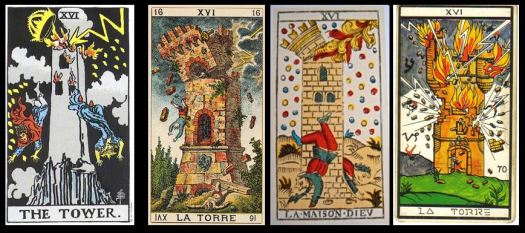
It Is The Number 16Th Card In Major Arcana In The Tarot.
In a spiritual context, the tower. The tower major arcana tarot card meaning & reversed card meaning in the context of love, relationships, money, career, health & spirituality all free! That’s the other key to interpreting the tower.
After A Tower Experience, You Will Grow Stronger, Wiser And More Resilient As You Develop A New Perspective On Life You Did Not Even Know Existed.
The tower moment is a very important time in your twin flame relationship. The tower tarot card is associated with the astrological zodiac sign aries and scorpio and planet mars. Detailed tarot card meaning for the the towerincluding upright and reversed card meanings.
That A Tower Is The Worship Of Self, Is Evident From The Signification Of A Tower.
A lightning bolt strikes the tower which sets it ablaze. The tower moment refers to the tarot card of the tower being struck by lightning while people are falling out of it. The tower moment refers to when your relationship feels like.

Post a Comment for "Tower Moment Spiritual Meaning"