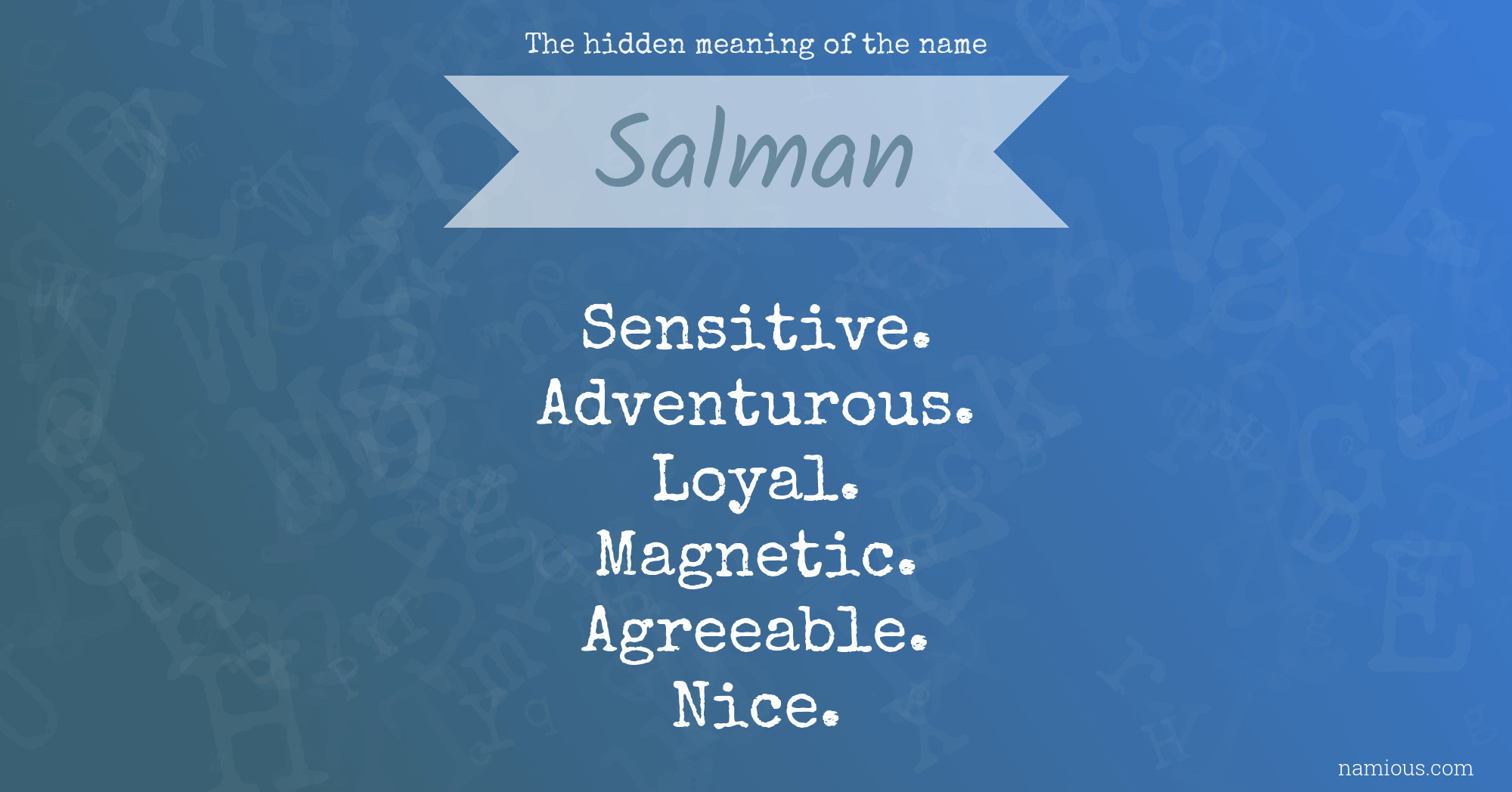
Meaning Of The Name Salman
Meaning Of The Name Salman. Salman is generally used as. The origin of the name lies in arabic.
The relationship between a symbol and its meaning is known as"the theory of Meaning. In this article, we will review the problems with truth-conditional theories on meaning, Grice's understanding of speaker-meaning, and an analysis of the meaning of a sign by Tarski's semantic model of truth. We will also consider evidence against Tarski's theories of truth.
Arguments against truth-conditional theories of meaning
Truth-conditional theories of meaning assert that meaning is the result on the truthful conditions. However, this theory limits the meaning of linguistic phenomena to. This argument is essentially that truth values are not always correct. Therefore, we should recognize the difference between truth and flat statement.
Epistemic Determination Argument Epistemic Determination Argument is an attempt to argue for truth-conditional theories on meaning. It relies on two key principles: the completeness of nonlinguistic facts and knowledge of the truth-condition. However, Daniel Cohnitz has argued against these assumptions. This argument therefore is unfounded.
Another issue that is frequently raised with these theories is the incredibility of the concept of. However, this problem is solved by mentalist analysis. In this way, meaning is analyzed in as a way that is based on a mental representation, rather than the intended meaning. For instance one person could get different meanings from the term when the same individual uses the same word in different circumstances, however, the meanings of these words could be similar depending on the context in which the speaker is using the same phrase in two different contexts.
While most foundational theories of significance attempt to explain interpretation in mind-based content other theories are often pursued. This could be due being skeptical of theories of mentalists. They may also be pursued by people who are of the opinion mental representation should be analyzed in terms of linguistic representation.
Another major defender of this idea is Robert Brandom. The philosopher believes that the value of a sentence in its social context as well as that speech actions which involve sentences are appropriate in the context in that they are employed. Therefore, he has created a pragmatics theory to explain the meanings of sentences based on traditional social practices and normative statuses.
The Grice analysis is not without fault. speaker-meaning
Grice's analysis based on speaker-meaning puts much emphasis on the utterer's intention and its relation to the meaning in the sentences. In his view, intention is an intricate mental state which must be considered in order to discern the meaning of the sentence. This analysis, however, violates speaker centrism through analyzing U-meaning without M-intentions. Furthermore, Grice fails to account for the fact that M-intentions are not specific to one or two.
The analysis also doesn't take into consideration some significant instances of intuitive communication. For example, in the photograph example that we discussed earlier, the speaker doesn't make it clear whether the message was directed at Bob himself or his wife. This is problematic since Andy's photo does not reveal the fact that Bob nor his wife is unfaithful or faithful.
Although Grice is correct in that speaker meaning is more fundamental than sentence-meanings, there is still room for debate. Actually, the distinction is crucial to the naturalistic integrity of nonnatural meaning. In the end, Grice's mission is to offer naturalistic explanations to explain this type of significance.
To understand a message we must be aware of the meaning of the speaker and that intention is a complex embedding of intentions and beliefs. However, we seldom make complex inferences about mental states in typical exchanges. Therefore, Grice's interpretation of speaker-meaning does not align to the actual psychological processes that are involved in understanding of language.
Although Grice's explanation of speaker-meaning is a plausible description about the processing, it's but far from complete. Others, including Bennett, Loar, and Schiffer, have come up with more precise explanations. However, these explanations reduce the credibility in the Gricean theory because they consider communication to be an intellectual activity. Essentially, audiences reason to accept what the speaker is saying as they comprehend what the speaker is trying to convey.
It does not account for all types of speech acts. Grice's approach fails to include the fact speech acts are frequently used to explain the meaning of sentences. In the end, the significance of a sentence is reduced to its speaker's meaning.
Problems with Tarski's semantic theory of truth
Although Tarski believed that sentences are truth bearers It doesn't necessarily mean that an expression must always be accurate. He instead attempted to define what constitutes "true" in a specific context. His theory has since become an integral part of contemporary logic, and is classified as deflationary theory or correspondence theory.
One problem with the notion to be true is that the concept cannot be applied to natural languages. This problem is caused by Tarski's undefinability theory, which claims that no bivalent one has the ability to contain its own truth predicate. Although English might seem to be an in the middle of this principle but it does not go along with Tarski's theory that natural languages are semantically closed.
Yet, Tarski leaves many implicit conditions on his theory. For instance it is not allowed for a theory to contain false sentences or instances of form T. That is, theories should not create what is known as the Liar paradox. Another issue with Tarski's idea is that it isn't aligned with the theories of traditional philosophers. In addition, it's impossible to explain all cases of truth in terms of the common sense. This is a major issue for any theories of truth.
The second issue is that Tarski's definitions for truth calls for the use of concepts in set theory and syntax. They're not appropriate when looking at endless languages. Henkin's style of language is sound, but it is not in line with Tarski's definition of truth.
It is also challenging because it fails to consider the complexity of the truth. Truth for instance cannot serve as a predicate in the context of an interpretation theory, the axioms of Tarski's theory cannot define the meaning of primitives. Furthermore, his definition of truth does not align with the notion of truth in meaning theories.
But, these issues don't stop Tarski from using Tarski's definition of what is truth and it doesn't conform to the definition of'satisfaction. The actual definition of truth is less than simple and is dependent on the specifics of object language. If you're interested in learning more about the subject, then read Thoralf Skolem's 1919 paper.
A few issues with Grice's analysis on sentence-meaning
The difficulties with Grice's interpretation of sentence meaning could be summarized in two main areas. First, the purpose of the speaker needs to be recognized. Additionally, the speaker's speech must be supported by evidence that demonstrates the desired effect. However, these conditions aren't observed in all cases.
This issue can be fixed by changing Grice's analysis of phrase-based meaning, which includes the meaning of sentences without intentionality. The analysis is based on the principle the sentence is a complex and have a myriad of essential elements. This is why the Gricean analysis is not able to capture instances that could be counterexamples.
This argument is especially problematic when we consider Grice's distinctions between meaning of the speaker and sentence. This distinction is fundamental to any account that is naturalistically accurate of sentence-meaning. This theory is also crucial to the notion of implicature in conversation. On the 27th of May, 1957 Grice provided a basic theory of meaning that expanded upon in later research papers. The basic notion of significance in Grice's research is to focus on the intention of the speaker in understanding what the speaker is trying to communicate.
Another issue with Grice's approach is that it doesn't take into account intuitive communication. For example, in Grice's example, it is not clear what Andy intends to mean when he claims that Bob is unfaithful and unfaithful to wife. However, there are plenty of variations of intuitive communication which cannot be explained by Grice's theory.
The main argument of Grice's approach is that a speaker has to be intending to create an effect in your audience. However, this assumption is not philosophically rigorous. Grice establishes the cutoff using variable cognitive capabilities of an contactor and also the nature communication.
Grice's explanation of meaning in sentences is not very credible, however, it's an conceivable theory. Others have provided more detailed explanations of significance, but they're less plausible. In addition, Grice views communication as an activity that is rational. The audience is able to reason through their awareness of the message being communicated by the speaker.
From a personal name based on arabic salmān‘safe’. The origin of the name lies in arabic. Means safe, derived from arabic سَلِمَ ( salima) meaning to be safe.
Salman Name Meaning And History.
The name salman is of persian origin. This name derives from the hebrew and arabic “shâlêm > salīm”, meaning “peaceful, complete”. It means that this name is very frequently used.
Matters Of The Heart Will Always Come First!
And we are pleased to let you know that we found the meaning of your name, safe. The name salman is ranked on the 1,066th position of the most used names. Salman is a boy name, meaning safe in tamil origin.
Salman Is An Arabic Name Dating Back To Salman The Persian, One Of Muhammad's Companions.
The name derives from the name. A companion of holy prophet saw. Only few know their names true essence.
Means Safe, Derived From Arabic سَلِمَ ( Salima) Meaning To Be Safe.
It is also of arabic origin, where its meaning is name of a friend of ali. The meaning of salman is name of a friend of ali. The male name salman is commonly used in arabic and turkish speaking countries and is sometimes spelt as salmaan or zalman.
What Is The Meaning Of The Name Salman?
Demographics) salman entered the list in 1992 and reached. Salman is a muslim boy name which originates from the arabic language.acording to numerology predictions, lucky number for salman is 1. Meaning of salman name, its origin, religion.

Post a Comment for "Meaning Of The Name Salman"